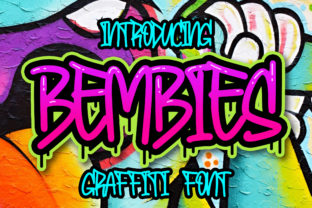
Bembies: Urban Typography That Fits Your Creative Workflow
Bembies is a display font rooted in graffiti-style lettering—bold, expressive, and unmistakably urban. It’s not designed for body text or long-form reading. Instead, Bembies thrives where impact matters: headlines, posters, social media visuals, branding accents, and short-form digital assets. Its strength lies in how it integrates into real creative workflows—not as a standalone novelty, but as a deliberate tool that supports intention, timing, and visual hierarchy.
Where Bembies Fits in the Creative Process
Typography choices rarely happen in isolation. They’re part of a sequence: research → concept → layout → refinement → delivery. Bembies enters most naturally during the concept and layout phases—when tone, audience, and medium are already defined. For example, a small business owner designing a limited-edition event poster doesn’t start with Bembies. They begin by clarifying the event’s energy (e.g., “raw,” “energetic,” “community-driven”) and the platform (e.g., Instagram carousel, printed flyer, storefront window). Only then does Bembies become a logical candidate—not because it’s trendy, but because its angular strokes and uneven baseline reinforce that specific energy without needing extra explanation.
It’s equally useful during refinement. If a design feels visually flat or generic, swapping a neutral sans-serif headline for Bembies can reintroduce personality—provided contrast and spacing are adjusted accordingly. That shift isn’t decorative; it’s diagnostic. It reveals whether the underlying composition can support expressive typography. If Bembies overwhelms the layout, the issue isn’t the font—it’s likely insufficient white space, weak color contrast, or competing visual elements.
Practical Integration Across Platforms and Tools
Bembies works best when treated like a specialized instrument—not the whole orchestra. In Figma or Adobe Illustrator, it’s common to pair it with a clean, highly legible sans-serif (like Inter, Poppins, or even system fonts) for supporting text. This pairing creates rhythm: Bembies sets the mood; the secondary font delivers information. That dynamic holds whether you’re building a Canva social post, a Notion presentation template, or a WordPress landing page header.
For web use, Bembies should be loaded selectively—ideally as a display-only web font. Avoid applying it to navigation menus, paragraph text, or form labels. Use CSS @font-face rules with font-display: swap to prevent render-blocking, and always define fallbacks (font-family: "Bembies", "Arial Black", sans-serif;). This ensures usability stays high even if the font fails to load.
In print workflows, confirm licensing covers commercial output—and verify glyph coverage. Bembies includes standard Latin characters and basic punctuation, but doesn’t support extended diacritics or multilingual scripts. If your project targets Spanish-speaking audiences or includes French accents, plan for manual substitution or alternate styling for those words.
Timing Matters: When to Use (and When Not to Use) Bembies
Use Bembies when:
- You’re designing for immediacy—think festival banners, podcast cover art, or email subject lines meant to stand out in an inbox.
- Your brand voice embraces authenticity over polish—streetwear labels, independent music releases, grassroots campaigns.
- You need visual shorthand for cultural context—urban culture, youth-led initiatives, DIY ethos—without relying on imagery alone.
Avoid Bembies when:
- Legibility is non-negotiable—accessibility requirements, small screen interfaces, or low-resolution outputs.
- The audience expects formality—legal disclaimers, academic reports, corporate annual reviews.
- You’re working under tight time constraints and haven’t tested rendering across devices. What looks sharp on your Retina display may pixelate on Android Chrome or older iOS versions.
Workflow Examples You Can Adapt
Bloggers & Content Creators: Use Bembies for featured image headlines—not article titles. Export a set of pre-sized banner graphics (1200×630px, 1080×1080px) with Bembies-based headers, then batch-upload them alongside drafts. This removes last-minute font decisions and keeps visual consistency across platforms.
Educators & Workshop Facilitators: Embed Bembies into slide templates for breakout session titles (“Rethink the Rules,” “Build Without Blueprints”). Its informal authority signals permission to experiment—subtly reinforcing pedagogical intent. Just ensure subtitle text remains in a highly readable font at minimum 24pt size.
Small Business Owners: Apply Bembies only to one element per customer-facing asset—for example, the tagline on a business card or the “Limited Stock” badge on a Shopify product page. This prevents visual fatigue while still anchoring the brand’s attitude. Track engagement: if CTR increases on buttons using Bembies-styled labels (vs. default UI text), you’ve confirmed its functional value—not just aesthetic appeal.
Long-Term Usability and Quality Control
Bembies isn’t a “set and forget” font. Its effectiveness degrades without ongoing attention. Overuse flattens its impact. Repeating the same Bembies treatment across every Instagram Story, email header, and PDF report trains viewers to ignore it—not engage with it. Build in review checkpoints: every 90 days, audit where Bembies appears publicly. Ask: Does this usage still serve a clear purpose? Has the surrounding design evolved enough to justify keeping it?
Also consider scalability. A Bembies headline that works at 48px on desktop may lose character at 24px on mobile. Test responsiveness early. In CSS, use clamp() to scale Bembies sizes fluidly: font-size: clamp(24px, 5vw, 48px);. This preserves impact without compromising readability.
Finally, treat licensing as part of your asset management system. Store the license file with your brand guidelines. Note expiration dates if using a subscription-based service. If switching to a self-hosted version, document the version number and update cadence—especially since display fonts occasionally receive spacing or hinting improvements that affect rendering.
Consistency Without Repetition
Consistency with Bembies means honoring its nature—not replicating it everywhere. That might look like using its stroke weight as inspiration for custom dividers, icon outlines, or border treatments elsewhere in your design system. Or adopting its irregular baseline as a subtle guide for photo cropping in social posts. These extensions keep the spirit alive without forcing the font itself into unsuitable contexts.
For teams, document usage rules clearly—not as restrictions, but as shared logic. Example: “Bembies appears only in primary headlines ≥36px, never in UI components or data tables. Secondary type is always Inter at 100% line height.” This reduces debate and speeds up approvals.
Bembies earns its place not by being everywhere, but by being unmistakably right—wherever it lands. It’s a reminder that typography isn’t just about letters. It’s about timing, restraint, and knowing exactly what job needs doing—and which tool does it best.