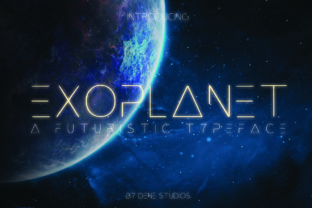
Exoplanet: Where Handcrafted Craft Meets Futuristic Typography
Typography isn’t just about legibility—it’s about voice, presence, and intention. When you’re designing a brand identity, launching a tech startup, or crafting an immersive digital experience, the typeface you choose becomes a silent ambassador. That’s where Exoplanet stands apart: not as another algorithmically generated font, but as a uniquely handcrafted display typeface built with deliberate artistry and forward-looking vision.
A Font Born from Passion, Not Parameters
Most display fonts today are engineered for scalability, compression, or broad language support—valuable goals, certainly. But Exoplanet begins elsewhere: in the quiet focus of a designer’s hand, translating motion, weight, and rhythm into vector curves. Every glyph was drawn, refined, and reimagined—not tweaked in a font editor, but felt through gesture and iteration. That human origin is palpable: subtle asymmetries in the ‘S’, a gently tapered terminal on the ‘a’, the way the ‘R’ balances geometric discipline with organic warmth.
This isn’t nostalgia for analog tools—it’s a commitment to nuance. In an age of AI-generated assets and templated UIs, Exoplanet offers something increasingly rare: authenticity with intention. It doesn’t try to be everything. It knows its role: commanding attention, establishing tone, and anchoring high-impact moments.
What Makes Exoplanet Feel “Futuristic”—Without Feeling Cold?
Futurism in typography often defaults to sharp angles, extreme contrast, or sterile minimalism. Exoplanet avoids those clichés. Its futurism lives in its confidence—not in cold precision, but in assured rhythm and spatial intelligence. Notice how letters breathe: generous side bearings, dynamic x-height proportions, and carefully tuned letterfit that invites reading rather than demanding it.
The uppercase ‘M’ has a soft apex—not rigidly pointed, but subtly rounded like a satellite dish catching signal. The lowercase ‘g’ features a closed, planetary counter, echoing its namesake without literal illustration. Even punctuation feels considered: the colon and semicolon align with optical centers, not mathematical ones. These details don’t shout—they resonate.
Where Exoplanet Fits Naturally (and Where It Doesn’t)
Exoplanet thrives where impact matters more than endurance. Think of it as the headline at the top of your hero section—not the paragraph beneath it. It’s ideal for:
- Brand logotypes—especially for tech-forward startups, creative studios, or innovation labs seeking distinction without sterility;
- Event titles and conference identities, where a single word like “Horizon” or “Nexus” needs gravitational pull;
- App splash screens and onboarding headers, giving users an immediate sense of sophistication and care;
- Printed posters and exhibition signage, where large-scale rendering reveals its sculptural subtlety;
- Animated intros and motion graphics, where its strong shapes hold up beautifully in keyframes and transitions.
It’s less suited—and intentionally so—for body text, legal disclaimers, or dense data tables. That’s not a limitation; it’s clarity of purpose. Using Exoplanet everywhere would dilute its power, much like playing a symphony’s crescendo on repeat. Its strength lies in contrast: pair it with a warm, highly readable sans-serif like Inter or Poppins for balance, and you create visual hierarchy that feels both modern and human-centered.
Practical Integration: From Sketch to Screen
Getting Exoplanet into your workflow is refreshingly straightforward. It ships in standard OpenType (.otf) and variable font (.woff2) formats—fully compatible with Figma, Adobe Creative Cloud, Webflow, and modern CSS @font-face declarations. No plugins, no licensing hoops for standard web or desktop use.
For developers: the variable version includes optical sizing axes, letting you fine-tune stroke contrast based on display size—crucial for maintaining legibility across mobile headlines and billboard-sized banners. Designers using Figma will appreciate the intuitive naming system (Exoplanet Bold, Exoplanet Light, etc.) and built-in stylistic sets for alternate numerals or discretionary ligatures.
One practical tip: always test Exoplanet at real-world sizes *before* finalizing layouts. Because it’s designed for display, smaller-than-intended usage (under ~36px on screen or 18pt in print) may obscure its nuanced terminals and spacing. Let it shine where it belongs—center stage.
Why Designers Are Choosing Exoplanet Over Generic Alternatives
In crowded design ecosystems, differentiation is currency. A generic sci-fi font says “I needed something fast.” Exoplanet says “I invested in meaning.” Clients notice that difference—not as a technical detail, but as a feeling of trust and coherence.
Consider a fintech dashboard redesign. Instead of defaulting to a sleek-but-familiar geometric sans, the team uses Exoplanet for section headers (“Portfolio Insights,” “Risk Forecast”). Instantly, the interface feels less transactional and more consultative—like it’s speaking to someone who values insight over speed alone.
Or imagine an indie game studio launching a narrative-driven space exploration title. Their logo, rendered in Exoplanet, conveys mystery and scale without leaning on clichéd star motifs or nebula textures. The font itself becomes part of the world-building—quietly reinforcing theme through form.
What to Consider Before You Commit
Because Exoplanet is a display font, ask yourself two questions before adopting it:
- What’s the primary message I need this text to carry? If it’s urgency, authority, or wonder—yes. If it’s neutrality, accessibility-first utility, or multilingual long-form content—consider pairing it thoughtfully rather than relying on it alone.
- Does my audience have context to receive its tone? Exoplanet communicates confidence and curiosity. It resonates strongly with audiences comfortable with digital fluency—developers, designers, early adopters—but may feel overly stylized for conservative sectors like healthcare compliance or municipal government portals unless deliberately grounded by supporting typography and color.
Also worth noting: while Exoplanet supports Latin-based languages comprehensively (including extended diacritics for French, Spanish, Polish, and Turkish), it does not yet include Cyrillic, Arabic, or CJK character sets. For global-facing projects requiring full script coverage, plan for typographic fallbacks—or use Exoplanet strictly for English branding elements alongside localized body fonts.
More Than a Typeface—A Design Philosophy Made Visible
At its core, Exoplanet reflects a growing shift in how we think about digital craft: not as something optimized for machines first, but as something shaped for people first—then refined for performance. Its hand-drawn origins aren’t a gimmick; they’re a reminder that even in futuristic contexts, humanity remains the center of gravity.
When you choose Exoplanet, you’re not just selecting a font—you’re aligning with a mindset that values patience over speed, specificity over scale, and resonance over reach. It won’t solve every typographic challenge. But for the right moment—the one where you need to stop scrolling, spark recognition, or invite deeper engagement—it doesn’t just work. It lands.
And in a world saturated with sameness, landing matters most.