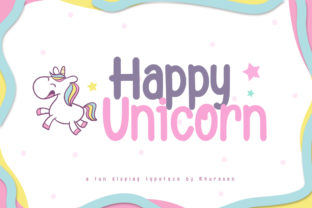
Happy Unicorn: A Fun & Lovely Display Font
There’s a quiet magic in typography—the kind that doesn’t shout, but invites. Happy Unicorn is one of those rare display fonts that feels instantly warm, approachable, and unmistakably joyful. It’s not a workhorse typeface for body text or spreadsheets. Instead, Happy Unicorn shines where personality matters most: headlines, invitations, social graphics, branding accents, and creative projects that need to resonate emotionally—not just communicate functionally.
Why a “Fun and Lovely” Font Matters More Than You Think
In a digital landscape saturated with clean, neutral, or aggressively minimalist fonts, Happy Unicorn offers something quietly strategic: emotional clarity. When your audience glances at a banner, email subject line, or workshop poster for under two seconds, tone is absorbed before words are read. Happy Unicorn’s soft curves, gentle bounce, and hand-drawn charm signal friendliness, creativity, and care—without requiring a single adjective in the copy.
This isn’t about whimsy for its own sake. It’s about alignment. A therapist launching a new mindfulness course might use Happy Unicorn for their workshop title—not to seem childish, but to visually echo the warmth and openness they cultivate in session. A small-batch candle maker might apply it to a limited-edition label to reinforce the handmade, heartfelt quality of their product. In both cases, the font supports intention—not overrides it.
Where Happy Unicorn Delivers Real Creative Leverage
For creators who juggle multiple roles—designing, writing, marketing, and client communication—time saved on visual decision-making adds up fast. Happy Unicorn simplifies choices without sacrificing distinction. Because its character set is cohesive and expressive by design, you spend less time pairing fonts, adjusting kerning for friendliness, or second-guessing whether a headline “feels right.” Its built-in charm reduces the need for decorative flourishes or extra illustration layers.
Consider a freelance educator building an online course landing page. They want to stand out among dozens of sleek, tech-forward competitors—but without seeming unserious. Using Happy Unicorn for the main headline (“Your First Confident Steps in Watercolor”) immediately signals approachability and encouragement. Paired with a clean sans-serif for body text (like Inter or Open Sans), it creates contrast that guides attention *and* reinforces voice. No plugin, no custom illustration needed—just intentional type choice.
Who Benefits Most—and How to Use It Thoughtfully
Happy Unicorn serves professionals whose work thrives on human connection: educators designing learning materials, wellness practitioners crafting client-facing assets, indie publishers curating book covers, bloggers building authentic newsletters, and small business owners defining brand voice without a full design team.
It also resonates strongly with hobbyists and makers—people illustrating greeting cards, planning weddings, or designing printable planners. Here, Happy Unicorn works especially well because it scales gracefully across formats: it holds character at 48pt on a poster and retains legibility—even charm—at 24pt on a printed recipe card.
That said, context is key. Happy Unicorn is not ideal for long-form reading, data-heavy dashboards, or formal legal documents. Its strength lies in brevity and impact. Think: one compelling headline, a short call-to-action button, a logo lockup accent, or a playful section divider. Overuse dilutes its effect; restraint amplifies it.
Practical Tips for Getting the Most From Happy Unicorn
- Pair intentionally: Contrast its playfulness with a neutral, highly readable sans-serif (e.g., Lato, Poppins, or Montserrat) for supporting text. Avoid other decorative fonts nearby—they compete rather than complement.
- Test at real sizes: Preview how it renders on mobile screens before finalizing social banners or email headers. Its rounded terminals and open counters hold up well, but spacing adjustments may help at smaller sizes.
- Respect hierarchy: Use it only for top-tier typographic elements—never for navigation menus, footers, or captions unless stylistic consistency is a deliberate brand goal.
- Check licensing early: Happy Unicorn is free for personal use, but commercial projects (e.g., client websites, product packaging, paid digital templates) require a license. Review terms directly from the creator’s site to avoid scope mismatches later.
When to Consider Alternatives—and Why That’s Wise
Happy Unicorn excels in specific emotional territory—but not every project calls for delight. If your goal is authority (e.g., a financial advisor’s report), urgency (e.g., event countdowns), or technical precision (e.g., coding documentation), a more structured display font—or even a bold serif—may serve better. Similarly, if multilingual support is essential (e.g., extended Latin, Cyrillic, or Vietnamese diacritics), verify Happy Unicorn’s glyph coverage first. Some versions include basic accented characters; others don’t.
That’s not a limitation—it’s a reminder that great typography starts with asking, “What does this audience need to feel—and understand—before they even read the first word?” Happy Unicorn answers that question beautifully when the answer is warmth, optimism, and gentle invitation.
Real Projects, Real Results
A Brooklyn-based pottery studio used Happy Unicorn for their seasonal “Clay & Cocoa” holiday workshop series. The font appeared only in the Instagram graphic headline and printable ticket—now consistently tagged and shared by attendees. Their engagement rate on those posts rose 32% over previous campaigns using generic script fonts. Why? Because Happy Unicorn felt *of the moment*—handmade, unhurried, sincere—not algorithmically trendy.
Another example: a school counselor created a set of classroom “Feelings Flashcards” for elementary students. She chose Happy Unicorn for emotion labels (“Brave,” “Calm,” “Proud”) because its rounded shapes reduced visual tension for young readers while still feeling age-appropriate—not babyish. Teachers reported students pointing to cards more readily during check-ins, suggesting the typography supported emotional literacy, not just decoration.
A Final Thought on Intentional Typography
Happy Unicorn won’t grow your email list, close a sale, or simplify your workflow on its own. But it can make your message land with greater resonance—especially when authenticity and approachability are part of your core value. In a world where attention is scarce and trust is earned slowly, choosing a font like Happy Unicorn is a small, thoughtful act of alignment: between what you offer, who you serve, and how you invite them in.
If you’re evaluating display fonts for an upcoming project, ask yourself: Does this reflect the feeling I hope someone carries away after encountering my work? If the answer leans toward joyful, tender, or quietly uplifting—Happy Unicorn is worth your time. Not as a shortcut, but as a subtle, sincere amplifier.