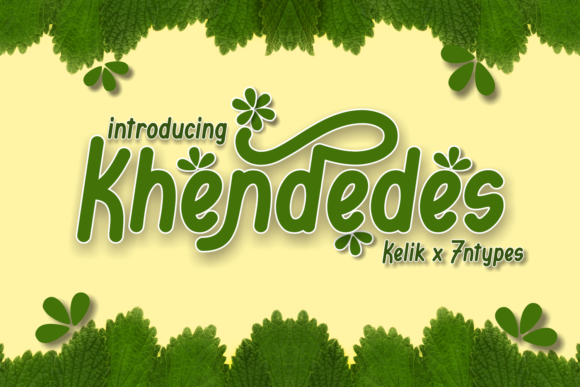
Khendedes Font
Khendedes is a display typeface designed for visual impact rather than extended reading. It features hand-drawn qualities—slight irregularities in stroke weight, organic terminals, and subtle variations in letterform rhythm—that lend it a natural, human-made feel. Unlike rigid geometric or highly polished sans serifs, Khendedes embraces imperfection as part of its character, making it well-suited for contexts where authenticity, warmth, or creative energy matter more than strict uniformity.
Who Might Consider Khendedes?
Designers, marketers, and content creators evaluating fonts for specific visual roles often seek typefaces that reinforce tone and intent at a glance. Khendedes appeals most strongly to those working on projects where personality and immediacy are priorities: event branding, editorial feature headers, social media graphics, product packaging for lifestyle or artisanal brands, and short-form digital banners. Its contemporary vibe stems not from trend-chasing aesthetics, but from a thoughtful balance of casual confidence and refined execution.
Key Benefits
- Natural expressiveness: The slight variation in stroke modulation and baseline alignment supports a relaxed, approachable tone without sacrificing legibility at larger sizes.
- Strong visual distinction: In crowded digital spaces—especially on mobile interfaces or thumbnail-heavy platforms—Khendedes stands out due to its confident x-height and open counters.
- Efficient pairing potential: Its informal yet structured nature pairs well with neutral, highly legible text fonts (e.g., modest sans serifs like Inter or Lato) without competing for attention.
- Consistent stylistic voice: Unlike some hand-lettered fonts that vary widely between weights or styles, Khendedes maintains a coherent aesthetic across its available variants, reducing inconsistency in multi-element layouts.
Tradeoffs and Practical Considerations
Khendedes is intentionally designed as a display font—not a text face. That distinction carries functional implications. At small sizes (below 24px), details such as tapered terminals and subtle contrast begin to blur, compromising clarity. Its rhythm and spacing are optimized for headline use, so setting body copy in Khendedes would hinder readability and accessibility compliance.
Another consideration is language support. Khendedes includes Latin-based characters and common diacritics, but does not extend to Cyrillic, Greek, or extended Asian language sets. Projects requiring multilingual typesetting—especially those serving global audiences—may need supplemental fonts or fallback strategies.
Licensing is also worth verifying early. While many display fonts are available under standard desktop or web licenses, usage rights for Khendedes vary depending on distribution method (e.g., direct purchase vs. subscription platform). Commercial applications involving merchandise, broadcast, or embedded software may require extended licensing.
When Khendedes Is a Strong Fit
Khendedes excels in scenarios where the goal is to establish mood quickly and memorably. For example:
- A café launching a seasonal menu with illustrated posters benefits from Khendedes’ warmth and tactile quality—reinforcing craft and care without appearing overly formal.
- An independent magazine using Khendedes for section headers creates visual hierarchy while maintaining editorial cohesion across diverse contributors and topics.
- A nonprofit campaign centered on community storytelling uses Khendedes in digital ads to signal openness and humanity—qualities reinforced by the font’s organic structure.
In each case, Khendedes serves as a deliberate design choice—not decoration. Its strength lies in supporting narrative intent, not substituting for it.
When Alternatives May Be Worth Exploring
Khendedes may be less appropriate when neutrality, scalability, or broad functionality take precedence. For instance:
- Long-form digital content: If your project involves substantial web-based reading—such as documentation sites, educational platforms, or news articles—prioritize fonts built for sustained legibility, like Merriweather, Source Serif Pro, or even system-ui stacks.
- Brands emphasizing precision or authority: Financial institutions, legal services, or technical tools often benefit from fonts with high x-heights, tight spacing control, and strong vertical stress—traits more commonly found in fonts like IBM Plex Sans or Roboto Flex.
- Tight production timelines: Because Khendedes relies on expressive nuance, fine-tuning spacing, kerning, or color contrast may require additional time during layout refinement—especially across responsive breakpoints.
Making an Informed Decision
Evaluating Khendedes isn’t about whether it’s “good” or “bad”—it’s about alignment. Ask yourself:
- What role does typography play in this project? If the font must convey personality before meaning, Khendedes is worth testing. If it must recede and serve information first, look elsewhere.
- At what sizes and in what contexts will it appear? Test real content—not just A–Z specimens—at intended sizes and on target devices. Pay attention to how letterforms hold up in low-resolution environments or under variable lighting conditions.
- Does it integrate smoothly into your existing typographic system? Try pairing Khendedes with your primary text font in actual layout mockups. Does hierarchy emerge clearly? Does contrast feel intentional—or jarring?
- Are your technical constraints compatible? Confirm file formats (WOFF2 for web, OTF/TTF for print), loading performance implications, and licensing scope before committing to implementation.
Finally, remember that typography functions best when it works in concert with other design decisions—color, imagery, layout rhythm, and interaction patterns. Khendedes can elevate a cohesive system, but it won’t compensate for inconsistent messaging or unclear user goals.
Final Thoughts
Khendedes offers a distinct voice among contemporary display fonts—one grounded in natural gesture rather than algorithmic polish. Its value emerges most clearly when used deliberately, within defined boundaries, and in service of a broader communication strategy. For readers comparing options, the question isn’t whether Khendedes fits every need—but whether its expressive qualities align with the specific impression, audience, and medium you aim to reach. Testing it alongside alternatives in real-world contexts remains the most reliable way to assess fit.