Le Gusto: A Playful, Modern Font for Expressive Design
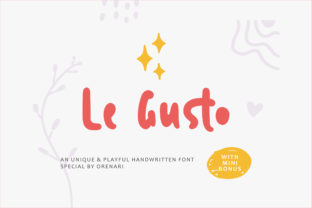
Le Gusto stands out as a distinctive display typeface designed to convey personality, warmth, and approachability. It’s not a workhorse font built for long-form readability—nor is it intended to blend into the background. Instead, Le Gusto leans into its playful nature with rounded terminals, uneven baseline rhythms, subtle hand-drawn imperfections, and generous letter spacing that invites attention. Its design balances modern minimalism with organic charm, making it especially effective where tone matters as much as legibility.
What Makes Le Gusto Distinctive
At first glance, Le Gusto reads as friendly and contemporary—but closer inspection reveals thoughtful craftsmanship. Characters like the lowercase a, g, and y feature soft, open counters and gently tapered strokes. Uppercase letters avoid rigid geometry; instead, they carry slight asymmetry and expressive weight shifts. The font includes alternate glyphs and ligatures that enhance its custom feel without requiring advanced typesetting knowledge. Unlike many script or handwritten fonts, Le Gusto maintains consistent x-height and rhythm across weights, supporting visual cohesion in short headlines, logos, packaging, or digital banners.
Its uniqueness lies less in novelty for novelty’s sake and more in how consistently it delivers on a specific emotional cue: lighthearted confidence. That makes it well-suited for brands, campaigns, or interfaces aiming to feel human-centered—not clinical, not overly casual, but intentionally warm and inviting.
Where Le Gusto Fits Among Display Fonts
Display fonts fall along a spectrum—from highly structured (like Montserrat Bold or Oswald) to fluidly handwritten (like Pacifico or Caveat). Le Gusto occupies a middle ground: more deliberate than freeform scripts, yet far more relaxed than geometric sans-serifs. It shares some DNA with fonts like Quicksand or Nunito in terms of rounded forms and friendliness, but diverges through its irregularity and emphasis on character over uniformity.
Compared to other “playful” options, Le Gusto avoids cartoonish exaggeration. It doesn’t rely on exaggerated swashes or exaggerated contrast to stand out. Instead, its distinction emerges from subtlety—slight variations in stroke width, gentle curvature, and intentional looseness in spacing. This gives it versatility in contexts where tone must remain professional but personable: think a boutique café’s menu board, an educational app’s onboarding screen, or a wellness brand’s seasonal campaign.
Strengths in Practice
Le Gusto excels where brevity meets intention. Its strengths are clearest in short-form applications:
- Logos and wordmarks: Its distinct letterforms hold up well at small sizes and scale cleanly for signage or app icons.
- Headlines and hero text: Paired with a neutral body font (e.g., Inter, Lato, or even Georgia), Le Gusto creates strong visual hierarchy without overwhelming.
- Product packaging and labels: Its warmth supports artisanal, food-related, or lifestyle brands seeking authenticity without cliché.
- Digital interfaces: Used sparingly—for call-to-action buttons, section headers, or illustrated tooltips—it adds expressive texture without compromising usability.
In each case, Le Gusto contributes tonal clarity. A tech startup targeting educators might use it for campaign landing pages to signal empathy and accessibility. A children’s book publisher could apply it to chapter titles—not for the whole text, but to evoke curiosity and joy. These uses succeed because Le Gusto isn’t trying to do everything; it’s optimized for moments where voice matters most.
Tradeoffs and Limitations
No font performs equally well across all conditions—and Le Gusto is no exception. Its primary limitation is functional scope. Because of its expressive proportions and rhythmic irregularities, it’s not suited for body copy, data tables, legal disclaimers, or interface elements requiring precise scanning (like form labels or navigation menus). At small sizes or low resolutions, some characters—particularly the lowercase e and s—can lose definition, reducing legibility.
Another consideration is licensing and technical support. Le Gusto is typically offered as a commercial font, meaning usage rights vary depending on context (web, desktop, app embedding). Users evaluating it for large-scale deployment should confirm whether their intended use falls within the license scope—and whether variable font support or extended language coverage (e.g., Central/Eastern European diacritics) is included.
Also worth noting: while its playfulness is a strength, it can unintentionally undercut seriousness. A financial advisory firm using Le Gusto for its main website headline may risk misalignment with audience expectations around trust and stability. Similarly, pairing it with overly decorative or clashing fonts dilutes its impact rather than enhancing it.
When Le Gusto Is the Right Choice
Le Gusto tends to be the right choice when three conditions align:
- The communication goal prioritizes tone and identity over neutrality. If your aim is to differentiate through warmth, creativity, or approachability—not authority, precision, or austerity—Le Gusto supports that objective directly.
- The application is short-form and visually prominent. It shines in contexts where users engage with text briefly and intentionally: a logo, a social media graphic, a poster, or a splash screen.
- Design execution allows for thoughtful pairing and restraint. Using Le Gusto effectively requires complementary typography—typically a clean, highly legible sans-serif or serif for supporting text—and disciplined application (e.g., one weight, limited sizes, consistent spacing).
Real-world examples include a sustainable skincare brand using Le Gusto for product name tags alongside a light-weight sans-serif for ingredient lists; or a community arts center applying it to event posters while keeping schedules and contact details in a highly readable system font. In both cases, Le Gusto functions as a signature element—not the foundation, but the accent that signals values.
When Another Option May Serve Better
Le Gusto isn’t ideal when consistency, scalability, or strict legibility requirements dominate. For instance:
- A government health portal needing clear, accessible information across devices would benefit more from fonts engineered for high contrast, large character sets, and WCAG compliance—like Open Sans or Roboto.
- A SaaS dashboard requiring dense, scannable UI text benefits from monospaced or tightly tuned sans-serifs (e.g., IBM Plex Mono or Fira Code) rather than expressive display faces.
- A multilingual publication needing broad Unicode coverage—including Arabic, Devanagari, or CJK glyphs—would need to verify whether Le Gusto offers those extensions before committing.
In these cases, the decision isn’t about Le Gusto being “worse,” but about functional fit. Choosing typography is rarely about finding the “best” font—it’s about matching the tool to the task, audience, and environment.
Making an Informed Decision
Evaluating Le Gusto means asking practical questions—not just “Do I like it?” but “Does it serve the user’s need in this context?” Start by testing it in your actual environment: render sample headlines at expected sizes on target devices, check contrast ratios against background colors, and assess how it pairs with your existing type system. Compare it side-by-side with alternatives—not just for aesthetics, but for how each supports your content goals.
If Le Gusto feels instantly resonant in early mockups, that’s a useful signal. But also ask: does that resonance come from genuine alignment—or from novelty wearing off quickly? Try setting the same headline in two or three different display fonts for 48 hours. Revisit them after a break. Which still feels appropriate, not just eye-catching?
Ultimately, Le Gusto earns its place when it deepens understanding—not distracts from it. It works best not as decoration, but as intentional voice. When used with purpose and precision, it becomes more than a font: it becomes part of the message itself.