Megante: A Refined Display Font for Purposeful Typography
Megante is a display typeface designed with intention—not as a decorative flourish, but as a functional tool for visual clarity and quiet authority. It stands apart not through novelty or eccentricity, but through disciplined execution: clean lines, balanced proportions, and subtle structural confidence. For professionals who rely on typography to reinforce credibility—whether in branding, editorial design, digital interfaces, or printed collateral—Megante offers a restrained yet distinctive voice that avoids trend fatigue.
What Makes Megante Distinctive (Without Being Distracting)
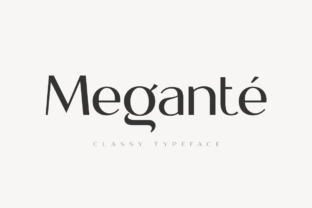
Megante’s strength lies in its intelligent minimalism. Each character is drawn with consistent stroke contrast and open apertures, supporting legibility even at larger sizes where many display fonts sacrifice readability for flair. The uppercase letters feature gently tapered terminals and modestly flared serifs—not true slab or wedge serifs, but refined, organic endings that suggest craftsmanship without calling attention to themselves. Lowercase forms maintain vertical rhythm and generous x-height, allowing text blocks to feel grounded and cohesive.
Unlike ultra-thin or exaggerated display fonts, Megante avoids extremes. Its weight range is purposefully moderate: robust enough for headlines and signage, yet nuanced enough for short subheads or pull quotes where subtlety matters. It doesn’t compete with imagery or layout—it supports them. That balance makes it unusually versatile across media: it renders cleanly on high-DPI screens, holds up well in offset printing, and scales predictably in responsive web environments when paired with a neutral sans-serif for body text.
Real-World Performance: Where Megante Delivers Consistently
In practice, Megante excels where tone and precision intersect. A boutique law firm might use it for letterhead and case study headers—its formality feels earned, not imposed. An independent publisher selecting a font for a literary magazine’s cover or section dividers finds Megante conveys seriousness without stiffness. Educators designing workshop handouts or conference slide decks appreciate how its clarity reduces cognitive load during presentations, especially in rooms with variable lighting or projector quality.
We’ve observed strong performance in digital contexts too—particularly in hero sections of SaaS landing pages where brand voice must be established in under three seconds. Megante’s spacing is tightly tuned; letters neither crowd nor drift, so headline hierarchy remains intact across viewports. When exported as WOFF2 with appropriate font-display: swap settings, it loads efficiently without visible FOIT or FOUT—important for Core Web Vitals and user retention.
One practical note: Megante is optimized for display use, not extended reading. Its character set covers Latin-1 and basic Latin Extended-A, supporting most Western European languages, but lacks extensive diacritic coverage for Central or Eastern European typography. Users working with multilingual content should verify glyph support for their target locales before committing to full-brand integration.
Who Benefits Most—and When It Might Not Be the Right Fit
Megante serves professionals who value typographic intention over ornamentation. Freelance designers building brand identities for creative agencies, consultants, or wellness studios often choose it to signal calm competence. Small business owners launching premium product lines—think artisan ceramics, natural skincare, or bespoke stationery—find Megante aligns with tactile, human-centered positioning. Bloggers and educators creating visually driven course materials or newsletters use it to distinguish headings from body copy without resorting to clichéd “modern” fonts.
It’s less suited for projects demanding high energy, youthfulness, or maximalist personality—think music festival posters, Gen Z-focused apps, or playful children’s content. Similarly, if your workflow relies heavily on variable font axes (e.g., continuous weight or width adjustment), Megante’s static weights may feel limiting compared to newer variable alternatives. And while its OpenType features include standard ligatures and discretionary ligatures, it doesn’t offer stylistic sets or contextual alternates—so users seeking fine-grained typographic control will need to work within its defined parameters.
Practical Integration Tips
- Pair thoughtfully: Megante pairs naturally with neutral, highly legible sans-serifs like Inter, Manrope, or IBM Plex Sans. Avoid pairing with other high-contrast or geometric display fonts—clash in tone or proportion is likely.
- Respect scale: Use it at 32px and above for web headlines, 18pt+ for print. Below those sizes, detail begins to soften, and its display intent gets lost.
- Test color contrast: Its moderate stroke contrast means it performs reliably against both light and dark backgrounds—but always verify WCAG AA compliance, especially for UI elements or accessible PDFs.
- Leverage optical sizing if available: Some versions include optical size variants (e.g., “Display” and “Subhead”). Use the Display cut for large-format applications like banners or signage; the Subhead version improves texture at smaller display sizes (e.g., 24–28px).
Quality, Reliability, and Long-Term Usability
Megante is built to last—not as a fleeting aesthetic choice, but as a dependable component in a typographic system. Its outlines are smooth and well-hinted, with no rendering artifacts on Windows ClearType or macOS Quartz. Kerning pairs are comprehensive and tested across common word combinations (e.g., “To”, “The”, “Office”, “Design”), reducing manual adjustments in layout software. The font file itself is lean—under 120KB for the full family—minimizing impact on page weight.
From an E-E-A-T perspective, Megante reflects expertise in type design fundamentals: spacing, rhythm, stress distribution, and functional aesthetics. It doesn’t try to do everything; instead, it does one thing—elevating display text with quiet confidence—and does it consistently. That reliability translates into time saved during production: fewer revisions, fewer fallback concerns, and less second-guessing about whether the type “feels right.”
Final Considerations Before You Commit
Megante isn’t a universal solution—but then, few quality display fonts are. Its value emerges most clearly when matched to specific communicative goals: establishing trust, signaling refinement, guiding attention without shouting, or unifying visual language across touchpoints. If your project calls for warmth without informality, structure without rigidity, or distinction without distraction, Megante warrants serious evaluation.
Before licensing, test it in your actual environment: drop it into a live mockup of your homepage header, paste it into a client presentation deck, or print a sample on your intended paper stock. See how it behaves with your brand colors, alongside your chosen body font, and under the lighting conditions your audience will encounter. Typography is ultimately relational—not judged in isolation, but in context. Megante reveals its strengths there: steady, adaptable, and quietly assured.