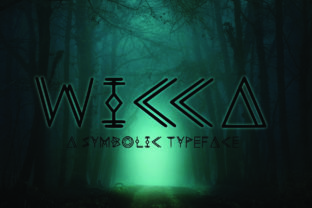
Wicca: A Spellbinding Display Font Rooted in Witchcraft Aesthetics
There’s a quiet shift happening in visual design—one where intuition, symbolism, and atmospheric resonance are gaining ground alongside clarity and function. Enter Wicca: a display font that doesn’t just look like it belongs on a grimoire—it feels like it was conjured there. Designed with deliberate nods to occult letterforms, hand-inked sigils, and the textured imperfection of vintage spellbooks, Wicca bridges esoteric tradition and contemporary typographic sensibility. It’s not novelty for novelty’s sake; it’s a response to how audiences now engage with authenticity, mood, and meaning in visual language.
More Than Just “Spooky”: Why Wicca Resonates Beyond Aesthetic Trends
Wicca isn’t merely a Halloween prop or a trend-chasing typeface. Its relevance emerges from deeper cultural undercurrents—particularly the growing appetite for design that carries intentionality and emotional texture. Professionals across branding, publishing, and digital media are moving away from sterile minimalism toward layered, story-aware visuals. A boutique skincare line might use Wicca for its limited-edition herbal tincture label—not to signal “witchcraft” literally, but to evoke craft, ritual, and quiet reverence for natural processes. Similarly, an indie podcast about folklore or mindful creativity may deploy Wicca in its cover art to suggest depth, mystery, and human-scale wonder.
This reflects a broader recalibration in user expectations: people increasingly respond to work that feels *human-made*, not algorithm-optimized. Wicca’s slight irregularities—the subtle variation in stroke weight, the tapered terminals reminiscent of quill pen pressure, the gentle asymmetry in glyphs like “a” and “g”—aren’t flaws. They’re cues that invite attention, slow down scrolling, and support narrative immersion. In a world saturated with frictionless, interchangeable UI fonts, Wicca offers a deliberate pause.
From Marginal Symbol to Mainstream Tool: How Wicca Fits Modern Workflows
Designers and marketers once reserved highly expressive typefaces for one-off campaigns or niche audiences. Today, tools like variable font support, improved web font loading, and accessible fallback strategies make intentional typography more viable than ever—even in responsive layouts. Wicca works best when used sparingly and purposefully: as a headline font paired with a neutral, highly legible text face (like a well-hinted serif or a warm sans-serif), or as a tactile accent in editorial design, packaging, or social media assets.
Consider a freelance educator launching an online course on mythic storytelling. Using Wicca for section headers in their course landing page adds tonal cohesion without sacrificing readability—especially when sized appropriately and spaced with care. Or imagine a small press releasing a chapbook of contemporary nature poetry: Wicca on the cover signals thematic alignment before a single word is read, reinforcing the publisher’s voice and values at a glance.
The key is context-aware application. Wicca thrives in environments where tone matters as much as information—where users arrive already open to atmosphere, reflection, or symbolic resonance. It’s less effective in dense data tables or legal disclaimers, not because it’s “unprofessional,” but because its strengths lie elsewhere: in evocation, identity, and emotional anchoring.
Evolving Expectations, Evolving Typography
Typography has long mirrored societal shifts. The clean geometry of mid-century modernism reflected postwar optimism and industrial precision. The resurgence of serif fonts in digital interfaces signaled a move toward warmth and authority. Wicca arrives amid another pivot—one toward meaning-infused minimalism. It’s part of a cohort of contemporary display faces (think: Marlowe, Thirsty Script, Amatic SC) that prioritize character over uniformity—but Wicca distinguishes itself through its consistent, respectful engagement with witchcraft iconography, without resorting to cliché.
What sets Wicca apart isn’t just its visual DNA, but its restraint. Unlike fonts that lean heavily into gothic ornamentation or exaggerated ligatures, Wicca maintains structural integrity. Its lowercase “y” features a modest curl—not a dramatic swirl. Its capital “W” echoes traditional calligraphic balance rather than theatrical flourish. This discipline makes it adaptable: equally at home on a ceramic mug label, a conference keynote slide, or a zine cover. It doesn’t shout; it invites interpretation.
Practical Considerations for Creators and Teams
Adopting Wicca thoughtfully means asking three questions:
- What feeling do we want this piece to carry? If the answer is “calm certainty,” “quiet curiosity,” or “grounded mystique,” Wicca may align. If the goal is urgency, neutrality, or technical precision, another option will serve better.
- Where does attention need to land—and for how long? Wicca excels in moments meant to be savored: titles, quotes, chapter openings, product names. It’s rarely ideal for body copy or navigation menus.
- Does our audience recognize—and appreciate—the nuance? Not every brand needs to signal esoteric literacy, but many do benefit from subtle cues of care, craftsmanship, or alternative thinking. Wicca communicates those values quietly, without explanation.
For developers and designers collaborating across platforms, Wicca performs reliably with standard web font protocols. It includes OpenType features like stylistic alternates and ligatures—useful for fine-tuning rhythm in headlines—but doesn’t require them to function. Pairing it with accessible color contrast (e.g., deep charcoal on cream rather than black on white) supports both aesthetic cohesion and readability standards.
Not Magic—Just Intentional Design
It’s worth underscoring: Wicca doesn’t cast spells. It doesn’t guarantee virality, conversions, or mystical insight. What it does offer is a tool shaped by thoughtful observation—of how people connect with symbols, how culture reclaims marginalized aesthetics with dignity, and how design language evolves alongside collective values. Its “spooky” quality isn’t about fear or gimmickry; it’s about tapping into something older and quieter—the human impulse to mark meaning, honor cycles, and express reverence through form.
That resonance explains why educators use Wicca in workshop handouts about seasonal mindfulness, why sustainable fashion brands apply it to tags describing natural dye processes, and why independent game studios choose it for title screens in narrative-driven adventures rooted in folk tradition. In each case, the font functions as a quiet collaborator—not drawing attention to itself, but deepening the coherence of the whole experience.
Moving Forward With Purpose
As AI-generated visuals flood feeds and templated design accelerates, distinctive, human-rooted typography gains new value. Wicca represents a small but meaningful counterpoint: a reminder that type can carry lineage, whisper intention, and hold space for ambiguity. It won’t replace system fonts in dashboards or replace clarity in accessibility-critical interfaces—and it shouldn’t. Its power lies in specificity, not universality.
For professionals weighing whether Wicca fits their next project, the question isn’t “Is this trendy?” but “Does this deepen what we’re trying to say—and who we’re trying to reach?” When the answer is yes, Wicca becomes more than a font. It becomes part of the story.