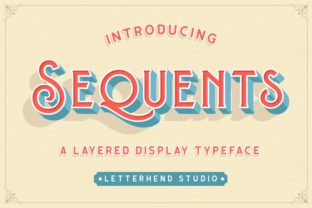
Sequents: A Layered Font for Expressive Text Effects
Sequents is a layered typeface designed to create dynamic, multi-tonal text through built-in shadow layers. Unlike standard fonts that render as single-color glyphs, Sequents provides multiple glyph variants—typically a base layer and one or more offset, semi-transparent shadow layers—that can be combined in design software to produce dimensional effects without manual vector manipulation.
This layered structure makes Sequents particularly useful when visual depth, subtle contrast, or tactile texture matters—such as in editorial headlines, branding applications, presentation slides, or digital interfaces where typographic hierarchy needs reinforcement beyond size or weight alone.
Why Consider Sequents?
Designers and developers often seek ways to add visual interest to typography while maintaining technical control and scalability. Sequents addresses this need by embedding layering logic directly into the font file, enabling effects that would otherwise require time-consuming manual layering in illustration tools or complex CSS stacking with multiple @font-face declarations.
Its appeal lies in consistency and efficiency: once installed and applied, the layered effect remains intact across edits, scaling, and export formats that support OpenType features or basic layer composition (e.g., Adobe Creative Cloud apps, Figma with plugin support, or modern browsers using variable font techniques).
Key Benefits of Using Sequents
- Predictable rendering: Because the layers are part of the font’s design—not generated via code or external assets—the appearance remains stable across environments where the font is properly loaded and supported.
- Scalability: As a vector-based font, Sequents maintains crisp edges at any size, unlike raster-based shadow effects that blur or pixelate when scaled.
- Workflow integration: Works within standard font-selection workflows in most design tools. No need for custom scripts or asset management for basic layer combinations.
- Customization potential: Some versions of Sequents include alternate layers (e.g., directional shadows, color-shifted variants) that can be toggled via OpenType features or manually selected in compatible software.
Tradeoffs and Technical Considerations
While Sequents offers distinct advantages, it also introduces constraints worth evaluating before adoption.
First, layered fonts require explicit support from both the application and the output context. Not all software treats layered glyphs uniformly: some may only display the base layer, ignore offsets, or misalign shadows due to differing rendering engines. Previewing in final delivery contexts—especially web browsers or mobile apps—is essential.
Second, file size tends to be larger than standard fonts. Each additional layer increases the font’s weight, which may affect page load performance if used on the web without proper subsetting or format optimization (e.g., WOFF2 compression, lazy loading).
Third, accessibility considerations apply. Layered shadows can reduce contrast between text and background if not carefully calibrated. Designers should verify that text meets WCAG 2.1 contrast ratios—particularly for body copy or interface labels—even when using Sequents for decorative headings.
Finally, licensing matters. Sequents is typically distributed under commercial licenses that may restrict web embedding, app bundling, or redistribution. Always confirm usage rights match your project’s deployment scope.
When Sequents Is a Strong Fit
Sequents excels in projects where controlled, repeatable dimensionality enhances communication without sacrificing typographic integrity.
It works well for editorial design, especially in magazine covers or digital newsletters where bold, textured headlines benefit from subtle depth without competing with imagery. In brand identity systems, Sequents can reinforce a modern, crafted aesthetic—particularly when paired with minimalist layouts that let typographic nuance carry visual weight.
For presentations and data visualization, its layered effect helps key metrics or section headers stand out against neutral backgrounds, improving scannability during live delivery. And in motion graphics or UI prototypes, designers can animate individual layers (e.g., shifting shadow position over time), leveraging Sequents’ structure for lightweight, scalable motion without raster dependencies.
When Alternatives May Be More Appropriate
Sequents is less suitable when simplicity, broad compatibility, or strict performance requirements take priority.
If your project targets legacy systems—such as older email clients, embedded displays, or PDFs generated from non-Adobe tools—standard fonts with CSS or SVG-based shadows will likely yield more consistent results. Similarly, for long-form web content where readability and speed are paramount, a highly legible, system-optimized font paired with minimal CSS text-shadow may deliver better user experience than a layered font requiring download and rendering overhead.
In cases demanding fine-grained control over shadow properties—like variable blur radius, opacity gradients, or responsive behavior based on viewport size—custom SVG text or CSS-driven solutions offer greater flexibility than Sequents’ fixed layer geometry.
Also consider alternatives if your team lacks familiarity with OpenType feature activation or layer management in their primary tools. The learning curve for unlocking Sequents’ full potential varies across platforms; what’s intuitive in Illustrator may require plugin assistance in Figma or custom CSS in web development.
Making an Informed Decision
Evaluating Sequents begins with clarifying your core objective: Are you aiming to solve a specific visual challenge (e.g., “How do I make headlines pop against busy backgrounds without adding image assets?”), or are you exploring stylistic options broadly?
If the former, test Sequents against real content in your intended environment. Import sample text into your production tool, simulate final output conditions (e.g., export to PNG at multiple sizes, preview in target browser), and assess legibility, alignment fidelity, and performance impact.
If the latter, compare Sequents alongside other layered or dimensional fonts—not just on aesthetics, but on documentation quality, update frequency, and community support. Fonts with clear guides, active issue tracking, and responsive foundries tend to integrate more smoothly into evolving workflows.
Finally, weigh effort versus outcome. Implementing Sequents correctly may require modest upfront time—configuring layers, adjusting spacing, verifying contrast—but can save hours over repeated manual shadow creation. For one-off projects or tight deadlines, simpler approaches may be more practical. For recurring brand use or template-driven systems, Sequents’ repeatability becomes a measurable advantage.
Ultimately, Sequents is not a universal replacement for standard fonts, nor is it merely a novelty. It is a specialized tool—one best evaluated not by how striking it looks in isolation, but by how reliably and efficiently it supports your specific communication goals across real-world conditions.